I grew up in a Quaker church. I didn't hear a lot about Jesus, but I did hear a lot about God and "that of God in every man." I didn't understand it at the time, but I just finished reading a Christian fiction book who's main character was a Quaker woman in Cincinnati, Ohio.
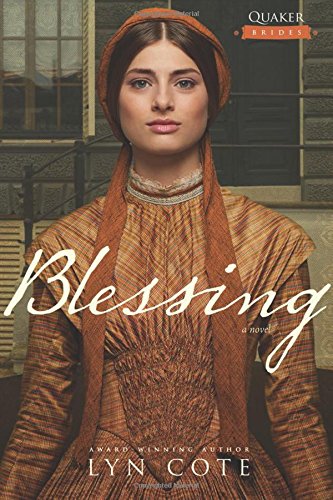
The book was titled Blessing by Lyn Cote. The story focuses on Blessing, Brightman. A young
widow of means who is very active in the underground railroad and in helping orphans and widows in Cincinatti, while advocating women's rights and abolition. Blessing is a very strong woman shaped by her past. Enter into the picture her best friend Tippy, her friend's beau--Stoddard, and Stoddard's cousin--Gerard Ramsay. Ramsay is determined that his cousin should stay single, but you can guess what happens in that regard. Ramsay sees something in Blessing and she in him. Blessing sees him as having the potential to be more than he is. Ramsay doesn't see a point at the beginning in becoming more than he is, but he changes.

The story was more interesting and engaging than I expected. It is a surprising story in that way for me. This is the first time I think I've read a fiction book about a Quaker community and so it provoked some questions in me. My knowledge of the Quakers is that they do not elevate the teachings of Christ and the Bible. This is true. For them, the revelations of the Holy Spirit is more important than the Bible. In Ohio, from what I read and researched online, this was the case of the Ohio Quaker Meetings at the time of the story. The book mentioned that some churches had gone to a programmed form of meeting--but doesn't mention that this is a move towards the Bible. It was a group of Evangelical Quakers who began programmed meetings.
But, the problem authors face when setting a story in a historical setting is that all the facts have to agree with how you tell the story. That is not the case from the quick research I did before writing this review. Sojourner Truth could not have spoken in Cincinatti at the time of this book. She went to Akron, Ohio in 1851, not in 1849. The story Ms. Truth is reported having told also isn't what I read online as well. I also struggled with how the Quakers were portrayed. In an unprogrammed Quaker meeting, all men and women are considered preachers. Very little is explained in this book about their meetings, though. Perhaps it was better explained in the first book of this series? I don't know. But, that would make this book not very good as a stand-alone.
But, the thing I would most want any reader to know about the Quakers is that they do not agree with Evangelical Christians about the essentials of salvation and the inerrancy--and importance of the Bible. Yes, the main character of this story is an admirable woman, but her church missed the Gospel.
The book is fine as a stand-alone story, but I think in some ways that the author missed the mark on her research. I enjoyed reading it because it challenged me to step back and understand my own experience in the Quaker church better.
Please note that I received a complimentary copy of this book from Tyndale Publishing.
The book was titled Blessing by Lyn Cote. The story focuses on Blessing, Brightman. A young
widow of means who is very active in the underground railroad and in helping orphans and widows in Cincinatti, while advocating women's rights and abolition. Blessing is a very strong woman shaped by her past. Enter into the picture her best friend Tippy, her friend's beau--Stoddard, and Stoddard's cousin--Gerard Ramsay. Ramsay is determined that his cousin should stay single, but you can guess what happens in that regard. Ramsay sees something in Blessing and she in him. Blessing sees him as having the potential to be more than he is. Ramsay doesn't see a point at the beginning in becoming more than he is, but he changes.
The story was more interesting and engaging than I expected. It is a surprising story in that way for me. This is the first time I think I've read a fiction book about a Quaker community and so it provoked some questions in me. My knowledge of the Quakers is that they do not elevate the teachings of Christ and the Bible. This is true. For them, the revelations of the Holy Spirit is more important than the Bible. In Ohio, from what I read and researched online, this was the case of the Ohio Quaker Meetings at the time of the story. The book mentioned that some churches had gone to a programmed form of meeting--but doesn't mention that this is a move towards the Bible. It was a group of Evangelical Quakers who began programmed meetings.
But, the problem authors face when setting a story in a historical setting is that all the facts have to agree with how you tell the story. That is not the case from the quick research I did before writing this review. Sojourner Truth could not have spoken in Cincinatti at the time of this book. She went to Akron, Ohio in 1851, not in 1849. The story Ms. Truth is reported having told also isn't what I read online as well. I also struggled with how the Quakers were portrayed. In an unprogrammed Quaker meeting, all men and women are considered preachers. Very little is explained in this book about their meetings, though. Perhaps it was better explained in the first book of this series? I don't know. But, that would make this book not very good as a stand-alone.
But, the thing I would most want any reader to know about the Quakers is that they do not agree with Evangelical Christians about the essentials of salvation and the inerrancy--and importance of the Bible. Yes, the main character of this story is an admirable woman, but her church missed the Gospel.
The book is fine as a stand-alone story, but I think in some ways that the author missed the mark on her research. I enjoyed reading it because it challenged me to step back and understand my own experience in the Quaker church better.
Please note that I received a complimentary copy of this book from Tyndale Publishing.
Comments