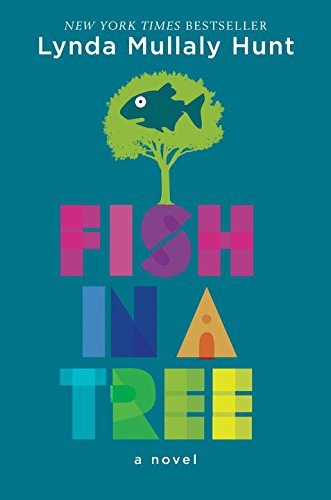
A Book I'm Going to Assign My Kids

This past weekend I read a book I found on someone's reading list on her blog.  The book was Fish in a Tree by Lynda Mullaly Hunt.

I loved it.  I'm glad I read it and I want my kids to read it.

The book is about a girl named Ally who struggles in school.  She's been in eight schools or so in seven years because her dad serves in the military.  Ally has an older brother, Travis, who has her back.  Their family is a healthy family, but Ally's dad is deployed during the story.

This book is a story about not judging a book by its cover.  Ally's MO is to distract whenever a teacher or school administrator asks her to read or write.  Because... Ally has dyslexia.  Over the years, her teachers missed it.  Her brother struggles with dyslexia as well.  Their parents know school is hard for them, but her dad likely had it as well and encouraged his son to compensate for it in auto class.

Dyslexia often runs in families.  A few years ago, I began learning a lot more about it and asked one of my friends a few questions.  I asked her if she'd ever been tested for dyslexia.  She asked her parents and they said no.  So, a few days later, she went online and took a test.  Turns out, two separate sites confirmed that she has dyslexia.  This story about Ally could have been my friend's story.  She had teachers who treated her like Ally had been treated.  We began talking about it--I asked her the question Mr. Daniels asks Ally in this story, "Do letters move for you?"  And my friend, like Ally told Mr. Daniels, told me that they always move.  My friend is now teaching her own children and I encouraged her to consider helping her children learn how to read using what she learned about how to compensate.

This story made me aware of several things.  First, teachers should read this story.  But, parents should too.  And I want my kids to read this story.  None of them struggle with reading, but reading this story will give them an idea of what it's like for someone who does.  There are other issues, too that are brought up.  One of Ally's friends doesn't have any food in the refrigerator at home.  Bullying comes into play as well.  There are some adults who are wrong in this story in how they treat the kids.  But, there are adults who try to love kids well, too.  The principal even apologizes to Ally after she learns she has dyslexia.  This is the world we live in.  It's the world the kids my life in.  I feel like so many books make the issues of this world too heavy for kids to handle.  But, this one brings up some of the tough parts of life in an age appropriate way.  The book is rated for grades 4-6, but I think this is a great book for students in grades 5-7.  I think it could stretch either way up to grade 8 or down to grade 4.  The reading level is 5th grade.


Comments

Popular posts from this blog

Missing Pieces

The other day I was discussing a book with my mom and explaining to her my concern about how "blame" is cast upon the child in the story.  My mom commented about how deeply I read and consider what is written. Sometimes I wonder if I go overboard.  Am I questioning too much?  Am I overreacting? Why am I reacting this way? I come back to knowing that God wired me this way.  But, I also reflect on how God has guided my path through the maze of books I've read over the past few years and what I've learned from the books themselves and from reading them.   Recently, I read a book that troubled me.  The book I finished reading was  Guiltless Living  by Ginger Hubbard.  When I began reading it, I found myself puzzled and then disconcerted. And in the end, I cried. But, I cried for a different reason than one might suspect. I'd like to explain. I did not read Ms. Hubbard's previous book “ Don't Make Me Count to Three ”, but I knew from f...

listening or rather not listening to directions...

This week has been very eye opening. I am observing and noticing what I need to learn in order to be a better homeschooling mom and teacher and what my daughter needs to learn to be a good homeschooling student. My weakness when I was a teacher in a first grade classroom was not understanding how small concepts had to be broken down--and I lost my patience very quickly. This week, in particular today, I am seeing how detailed my directions need to be. I am going to be working very consciously and deliberately on this. On the other hand, I realized that my daughter does not listen! Wowsers! In a classroom, Autumn listens very well. She is a compliant child and very influenced by peer pressure and conformity. So, she listens along with everyone else and follows directions. But, at home, it's just Autumn and maybe Sami and Mommy. Very, very different! I had forgotten that most of kindergarten in the public schools is not focused on teaching students academic and learning co...

Writing A Homeschool Teacher Resume

I'm helping a friend who's switching jobs write a resume.  She hasn't written one in years, so this is something new.  I began working on her resume, but then stopped to write my own because I thought it might be helpful.   Being a homeschool teacher may not seem to many like an occupation or career, but it is.  I used the combined form of resume for myself.  I began with the basic information, then moved on to strengths (the combined skills/experience part), education, Occupational Experience, then Related Experience, Certifications, Computer Skills, and mentioned at the end... References Available Upon Request.   Sometimes homeschooling parents have to reenter the workplace because of family changes and needs.  How could you express what you've been doing in a way that's acceptable for a resume? Well, here's my take on it... Teacher, Homeschool                  ...