Just the facts, Ma'am! I can picture a policeman on a tv show from the 1950s saying that to a woman in an a-line dress at the front door with a pad of paper in his hands.
If it were only so easy! Knowing the facts, that is.
As a kid, the kinds of facts I learned were my math facts. I don't remember ever having a hard time learning them. I just learned them. I can't remember not knowing them. I also don't remember my mom quizzing me on them. At times, I've wondered if my teachers all just gave us a magic pill that gave us the gift of knowing our math facts. No, not really. I know they didn't really do that. But, I do wonder how I learned them.
For my kids, learning there math facts has not been easy. My children are all much more language oriented than number oriented. As a result, I have been on a quest for several years seeking keys to help unlock this box of knowledge for my kids so that they could acquire and use their math facts easily. I've found a few helpful resources over the years.
The first tool I found was xtramath.org. This was the key that helped my oldest daughter memorize and learn all of her facts for addition, subtraction, multiplication, and division. It worked very well for her.
But, it wasn't the cureall that I hoped it would be for my younger two children. I modified the program and used the 6 second timed program with my middle daughter for addition and subtraction. But, her frustration level with the math facts led her to procrastinate and daydream when she was using the program so I knew I needed to switch gears with her.
I began using paper sheets of facts. She completed half a page a day. The more she used the facts the easier they became for her to recall. Time and repetition has helped. But, there were still a few facts that wouldn't stick. So, I began searching again for another helper!
I found that helper in a book by Susan Greenwald, Five Times Five Is Not Ten. This book shares tricks on how to learn the multiplication facts up to 9s. At the beginning of the book, the author has
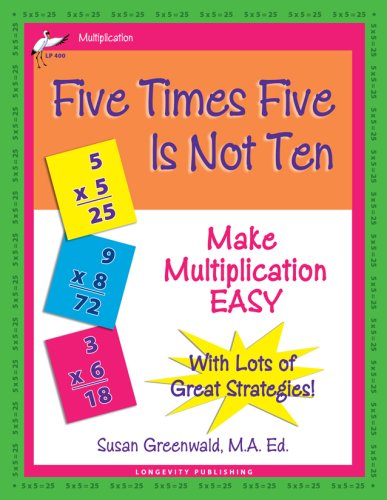 included directions on how to use the book and there is a baseline sheet to record what a child has learned. I appreciate that the book is reproducible for the individual who owns the book so that I can recopy sheets for each of my children and I don't have to buy a second book. What I found was that my daughter knew many of the facts in the book automatically, but that I could use the pages I needed for the facts that she needed a little extra help with. I like how the pages are formatted. Students have enough room to write the answer by each fact and there isn't any distracting froofiness. This book has been very helpful!
In the case of my son, Ms. Greenwald's book Two Plus Two Is Not Five, has been helpful to him. The book is structured the same as the multiplication fact book with directions at the front and a
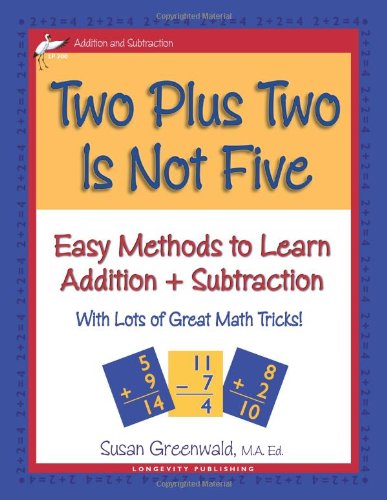 baseline sheet at the back. It is also reproducible (very important to me!). Before I used this book, I had been using subtraction fact sheets from a free online site. But, what I found was that the facts were added in too quickly. My son needed more practice and reinforcement. My son is making progress and I can see that his addition facts are coming along. This book's worksheets are giving him that. He doesn't have to use the tricks if he can memorize the facts for a given number easily, but if he needs the tricks--they're there.
A child doesn't have to learn all of the tricks. The tricks are helpful if a fact (or group of facts) aren't sticking. It's like looking at a wall that you can't climb straight over. You need to get around, so you start looking around for another way. A few feet away you see big rock near the base of the wall that you can step onto and use to boost yourself up and climb over the wall. That's the role of these tricks--to be that little extra boost your child needs to get over the wall when needed.
In connection with the books that Ms. Greenwald has put together to help children master their facts, she has also compiled a book of worksheets to work on addition and subtraction with regrouping (and without), Addition and Subtraction: Beyond Math Facts. My son is working on regrouping with
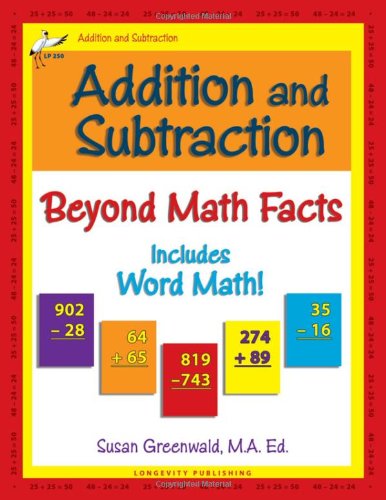 three digit subtraction in his second grade math book. It's challenging for him, but I can see that he understands it. When we finish his second grade math book in a few weeks, I'm going to take some time to give him some extra practice with 3 digit regrouping before we move on. These worksheets will be perfect for him for several reasons. First, I can give him some easier sheets to practice with regrouping to the tens place. Then, he can review adding two 2-digit numbers and regrouping. Then, we can practice three digit addition and subtraction with regrouping. Second, the numbers are clear and easy to see. There is space for him to work above and below each problem (very important!). Finally, I appreciate the mixed practice sheets that throw in easy problems with the harder ones. I have found that it's discouraging to students when every problem takes a lot of work. I'm glad to have this workbook in our Math arsenal.
The longer I teach and watch students learn math, the more I realize how essential it is for students to learn their math facts and know them by heart! I want my children to be able to focus on the new skills they're learning in math each day and not get bogged down by trying to recall the facts... I'm thankful that I can see they are all making progress and remembering more week by week!
Please note that I received complimentary copies of these books by Susan Greenwald for review.
If it were only so easy! Knowing the facts, that is.
As a kid, the kinds of facts I learned were my math facts. I don't remember ever having a hard time learning them. I just learned them. I can't remember not knowing them. I also don't remember my mom quizzing me on them. At times, I've wondered if my teachers all just gave us a magic pill that gave us the gift of knowing our math facts. No, not really. I know they didn't really do that. But, I do wonder how I learned them.
For my kids, learning there math facts has not been easy. My children are all much more language oriented than number oriented. As a result, I have been on a quest for several years seeking keys to help unlock this box of knowledge for my kids so that they could acquire and use their math facts easily. I've found a few helpful resources over the years.
The first tool I found was xtramath.org. This was the key that helped my oldest daughter memorize and learn all of her facts for addition, subtraction, multiplication, and division. It worked very well for her.
But, it wasn't the cureall that I hoped it would be for my younger two children. I modified the program and used the 6 second timed program with my middle daughter for addition and subtraction. But, her frustration level with the math facts led her to procrastinate and daydream when she was using the program so I knew I needed to switch gears with her.
I began using paper sheets of facts. She completed half a page a day. The more she used the facts the easier they became for her to recall. Time and repetition has helped. But, there were still a few facts that wouldn't stick. So, I began searching again for another helper!
I found that helper in a book by Susan Greenwald, Five Times Five Is Not Ten. This book shares tricks on how to learn the multiplication facts up to 9s. At the beginning of the book, the author has
In the case of my son, Ms. Greenwald's book Two Plus Two Is Not Five, has been helpful to him. The book is structured the same as the multiplication fact book with directions at the front and a
A child doesn't have to learn all of the tricks. The tricks are helpful if a fact (or group of facts) aren't sticking. It's like looking at a wall that you can't climb straight over. You need to get around, so you start looking around for another way. A few feet away you see big rock near the base of the wall that you can step onto and use to boost yourself up and climb over the wall. That's the role of these tricks--to be that little extra boost your child needs to get over the wall when needed.
In connection with the books that Ms. Greenwald has put together to help children master their facts, she has also compiled a book of worksheets to work on addition and subtraction with regrouping (and without), Addition and Subtraction: Beyond Math Facts. My son is working on regrouping with
The longer I teach and watch students learn math, the more I realize how essential it is for students to learn their math facts and know them by heart! I want my children to be able to focus on the new skills they're learning in math each day and not get bogged down by trying to recall the facts... I'm thankful that I can see they are all making progress and remembering more week by week!
Please note that I received complimentary copies of these books by Susan Greenwald for review.
Comments