A while back, I wrote a review about YWAM's series of biographies of Christian Heroes from history. Last week, I had the chance to read one of the books from their Heroes of History series. I liked it, but I liked it even better with the corresponding Unit Study guide. I'd like to tell you about it and how I felt as I read the book.
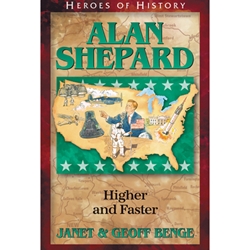
 I read the biography of Alan Shepard: Higher and Faster by Janet and Geoff Benge. I realized as I read how little I knew about the development of Aviation and aeronautical history. I learned so much! It was quite interesting to me. As I read the story of his life, I was struck early on by how competitive this man was. I was also struck, as a wife and mom, by how much of his life he was absent from his family. I struggled with these two facets of his life as I read through the book, but I pressed on. I discovered that after he retired from the Navy and NASA, he went on to pursue philanthropic efforts. He gave much of himself to others. He did also commit to raising his wife's sister's daughter when she passed away. Yet, I was still puzzled as to how to feel towards this man who was extremely competitive and struck me as possibly abrasive towards others. In fact, he was known for having rough edges. But, what I didn't know when I finished the book prompted me to begin searching for more about this man and about space travel.
I learned that Alan Shepard was a very private man. He did co-author one autobiography of himself and other astronauts, Moon Shot: The Inside Story of America's Race to the Moon. It is one of the sources the Benges list in their bibliography at the back of the book. I discussed the book with my husband and he explained to me that in order to do what Alan Shepard did, he needed to be extremely competitive--to have the drive in order to persevere against the odds and when things were tough. Indeed, his competitiveness was of great value to him in this sense. I also struggled with the realization that only college graduates were considered when NASA was beginning. It seemed rather elitest for that time to me. But, my husband explained that in order to be an astronaut, someone needed to have the skills and knowledge that came from attending college. I knew he was right.
But, it was actually the curriculum guide that set my heart at ease and helped me respect Alan Shepard more deeply. It was the curriculum guide that helped me see him as a flawed man, but as one worthy of respect. In the curriculum guide, there are comprehension and discussion questions for each chapter. These questions follow Bloom's Taxonomy (see here for more information: http://www.odu.edu/educ/roverbau/Bloom/blooms_taxonomy.htm) for comprehension. The first questions are aimed at recall and then they progress up the triangle towards analyzing and evaluating. The essay questions in the guide take what the student has learned and moves to the top of the pyramid of "creating". We are all flawed and it is easy for biographies to present someone as an ideal hero. This seems dangerous to me. But, the Benges' book did not portray Shepard as a perfect man. I am thankful for this. The book and comprehension guide will help students see Shepard's strengths and flaws that they might learn from and be encouraged by his example.
This book is one of a series of books on historical heroes. The Benges have chosen a variety of people from different occupations to write about from the course of American History. YWAM has posted a plan of how one might use these to help teach American History. http://ywampublishingftp.com/websitePDF/HHHomeschoolOverviewGuide.pdf They have posted separate guides for classrooms and for homeschoolers. The link above is for the homeschool guide. I am planning on using these books for our American History studies according to this guide. I will purchase the books with the corresponding curriculum guides (which I think are just as important). Along with this guide, I am going to use an abbreviated book about American History and form a timeline with my children. We will compile a notebook containing maps, discussion questions, essays and projects from these curriculum guides and History Pockets.
YWAM has a wonderful page on their website where you can access helpful information about the series and how you can use it: http://www.ywampublishing.com/c-78-heroes-series-bonus-material.aspx
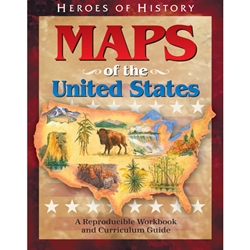
 YWAM has published a book of maps that are perfect for this unit and for other history studies of the United States. In the book, you'll find a basic map of the United States with an information sheet to fill out about the United States. Then there is a map and corresponding inquiry sheet for each of the 50 states. Following these maps are several historical maps for the 13 colonies, the Louisiana Purchase, and the Civil War. Below the forms are lists of locations for students to place on the maps. At the end of the book, is a list of activities and ways to use this book. I am going to incorporate this book into our state studies for 4th grade and American History Studies in 5th and 6th grades. You can see a preview of the book here: http://www.ywampublishing.com/p-664-maps-of-the-united-states-workbook.aspx or here: http://ywampublishingftp.com/websitePDF/MOTUSMaps
Let me be honest, I did not expect to like this series or that map book as much as I have. But, I love it! I do think that the curriculum guides are essential. I am not going to give my children one of the books to read without also going over the comprehension questions with them. I want them to learn about life--the good and the hard parts. I want them to see that the people who they are reading about are admirable, flawed people. No one is perfect. I think the curriculum guides do a wonderful job of teaching students how to think through what they read about people--to see all sides. We study history that we might learn from it--to learn from the good and the bad.
One last note...I do also want to talk to her about what role faith in God has played in their lives. For Alan Shepard, it does not seem that faith played a part. His wife was known to be a strong Christian Scientist (who though they believe in Jesus, do not believe evil is real). The Christian Heroes Series and curriculum guides by the Benges address how people lived out their faith.
Usually, I am not quite so blatant about my recommendations, but I do highly recommend this series of books and the curriculum guides. I also do recommend the Maps book if you are looking for a book of US Maps to supplement your cross curriculum studies.
Please note I received a complimentary copy of the Alan Shepard biography, curriculum guide, and Maps of the United States from YWAM Publishing for review.
I learned that Alan Shepard was a very private man. He did co-author one autobiography of himself and other astronauts, Moon Shot: The Inside Story of America's Race to the Moon. It is one of the sources the Benges list in their bibliography at the back of the book. I discussed the book with my husband and he explained to me that in order to do what Alan Shepard did, he needed to be extremely competitive--to have the drive in order to persevere against the odds and when things were tough. Indeed, his competitiveness was of great value to him in this sense. I also struggled with the realization that only college graduates were considered when NASA was beginning. It seemed rather elitest for that time to me. But, my husband explained that in order to be an astronaut, someone needed to have the skills and knowledge that came from attending college. I knew he was right.
But, it was actually the curriculum guide that set my heart at ease and helped me respect Alan Shepard more deeply. It was the curriculum guide that helped me see him as a flawed man, but as one worthy of respect. In the curriculum guide, there are comprehension and discussion questions for each chapter. These questions follow Bloom's Taxonomy (see here for more information: http://www.odu.edu/educ/roverbau/Bloom/blooms_taxonomy.htm) for comprehension. The first questions are aimed at recall and then they progress up the triangle towards analyzing and evaluating. The essay questions in the guide take what the student has learned and moves to the top of the pyramid of "creating". We are all flawed and it is easy for biographies to present someone as an ideal hero. This seems dangerous to me. But, the Benges' book did not portray Shepard as a perfect man. I am thankful for this. The book and comprehension guide will help students see Shepard's strengths and flaws that they might learn from and be encouraged by his example.
This book is one of a series of books on historical heroes. The Benges have chosen a variety of people from different occupations to write about from the course of American History. YWAM has posted a plan of how one might use these to help teach American History. http://ywampublishingftp.com/websitePDF/HHHomeschoolOverviewGuide.pdf They have posted separate guides for classrooms and for homeschoolers. The link above is for the homeschool guide. I am planning on using these books for our American History studies according to this guide. I will purchase the books with the corresponding curriculum guides (which I think are just as important). Along with this guide, I am going to use an abbreviated book about American History and form a timeline with my children. We will compile a notebook containing maps, discussion questions, essays and projects from these curriculum guides and History Pockets.
YWAM has a wonderful page on their website where you can access helpful information about the series and how you can use it: http://www.ywampublishing.com/c-78-heroes-series-bonus-material.aspx
Let me be honest, I did not expect to like this series or that map book as much as I have. But, I love it! I do think that the curriculum guides are essential. I am not going to give my children one of the books to read without also going over the comprehension questions with them. I want them to learn about life--the good and the hard parts. I want them to see that the people who they are reading about are admirable, flawed people. No one is perfect. I think the curriculum guides do a wonderful job of teaching students how to think through what they read about people--to see all sides. We study history that we might learn from it--to learn from the good and the bad.
One last note...I do also want to talk to her about what role faith in God has played in their lives. For Alan Shepard, it does not seem that faith played a part. His wife was known to be a strong Christian Scientist (who though they believe in Jesus, do not believe evil is real). The Christian Heroes Series and curriculum guides by the Benges address how people lived out their faith.
Usually, I am not quite so blatant about my recommendations, but I do highly recommend this series of books and the curriculum guides. I also do recommend the Maps book if you are looking for a book of US Maps to supplement your cross curriculum studies.
Please note I received a complimentary copy of the Alan Shepard biography, curriculum guide, and Maps of the United States from YWAM Publishing for review.
Comments
Today, perhaps more than ever, we need role models of true character and faith (not of show and fame). This is why we have published both the “Christian Heroes Then & Now” and “Heroes of History” series. Your review confirms that we are on the right track.
Thank you again for your kind words.
Warren Walsh
YWAM Publishing / Emerald Books