When my oldest daughter was in kindergarten, I remember a mom telling me that she had to use different curriculum with each of her children. I also clearly remember my reaction! Inside I recoiled at the thought of having to buy new curriculum for each of my children--I had no idea how I would afford to do that! It was also hard for me to imagine that my children wouldn't be able to use the same curriculum. I had been a classroom teacher and I used the same curriculum for all of the students in my class.
But, in time, I found the other mom's statement to be partially true, but only partially. Many homeschooling materials appeal to one style of learner more than another or they aren't easily leveled to different abilities levels within the same grade level. So, often when kids learn differently, parents have to buy different curriculum for each one. This is one reason why I've gravitated to public school textbooks over the years. Public school books tend to integrate multiple learning styles and lend themselves to differentiated learning. For grades 1-6, I used Harcourt Trophies for Language Arts. At the end of each lesson, there were 4 activities I could assign. The directions were general, so I could decide the length of the assignments and which ones were right for my kids.
The term differentiated learning, aka differentiation, is a funny one to me. It is what homeschool parents do all the time without calling it that. But, it's the phrase classroom teachers use to describe what they do and what we do to help our students. In homeschooling, we all modify our curriculum and choose curriculum that's appropriate for our kids--for their reading level, for their learning styles, and basically for how they learn best. When we become students of our students, we differentiate their learning.
How can one avoid having to buy multiple curriculum for the same grade level if your children learn very differently and are not all at the same ability level in a given grade level? You can do two things--you can either differentiate learning using the same books or you can buy curriculum that has multiple levels already included in it. One good example of this is Evan-Moor's Nonfiction Reading Practice books.
It's easy to build a language arts curriculum around fiction, but learning how to read and understand grade level nonfiction passages is really important, too. This series by Evan-Moor includes 17 topics. There are three leveled passages for each topic with coordinating questions and a writing topic. The topics are on social studies, science, math, technology, and the arts. The topics are interesting. The books are reproducible, so you only need to copy the pages needed for each child. The writing paper has wide, clear lines.
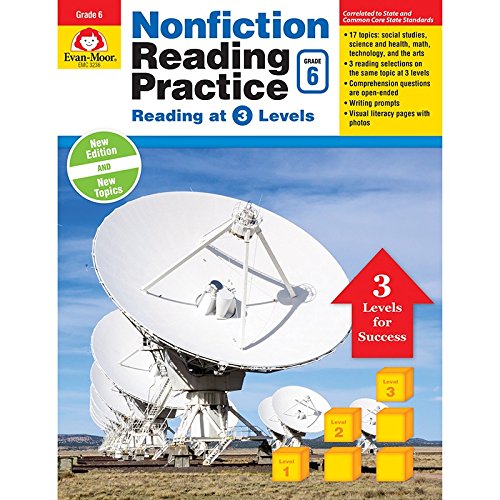 I'm going to be using the grade 6 book from this series this upcoming school year with my middle daughter. I plan on using one passage from this book each Monday. On Monday, I'll have her read the passage silently, then we'll read it together and then highlight or underline the most important sentences (3-4 at most). I will then ask her to list the sentences. On Tuesday, we'll work on paraphrasing those sentences and writing a summary. On Wednesday, I will assign the questions--which include short 1 sentence responses and multiple choice. Thursday, she'll begin her writing assignment by completing a graphic organizer and then spend time on Thursday and Friday writing a response.
I'm looking forward to using this book. It will make my life as a teacher easier. I love writing curriculum and modifying it, but I actually have less planning time as a homeschooler than I did when I was teaching in a formal classroom setting. I need to be able to grab a book and go! I hit the ground running, so to speak every hour of every day. I have three children at three completely different grade levels, so it's a lot to juggle! Books like this series by Evan-Moor make life simpler for me and I'm very grateful!
Please note that I did receive a copy of the grade 6 Nonfiction Reading Practice book from Evan-moor for review, but these opinions are entirely my own.
But, in time, I found the other mom's statement to be partially true, but only partially. Many homeschooling materials appeal to one style of learner more than another or they aren't easily leveled to different abilities levels within the same grade level. So, often when kids learn differently, parents have to buy different curriculum for each one. This is one reason why I've gravitated to public school textbooks over the years. Public school books tend to integrate multiple learning styles and lend themselves to differentiated learning. For grades 1-6, I used Harcourt Trophies for Language Arts. At the end of each lesson, there were 4 activities I could assign. The directions were general, so I could decide the length of the assignments and which ones were right for my kids.
The term differentiated learning, aka differentiation, is a funny one to me. It is what homeschool parents do all the time without calling it that. But, it's the phrase classroom teachers use to describe what they do and what we do to help our students. In homeschooling, we all modify our curriculum and choose curriculum that's appropriate for our kids--for their reading level, for their learning styles, and basically for how they learn best. When we become students of our students, we differentiate their learning.
How can one avoid having to buy multiple curriculum for the same grade level if your children learn very differently and are not all at the same ability level in a given grade level? You can do two things--you can either differentiate learning using the same books or you can buy curriculum that has multiple levels already included in it. One good example of this is Evan-Moor's Nonfiction Reading Practice books.
It's easy to build a language arts curriculum around fiction, but learning how to read and understand grade level nonfiction passages is really important, too. This series by Evan-Moor includes 17 topics. There are three leveled passages for each topic with coordinating questions and a writing topic. The topics are on social studies, science, math, technology, and the arts. The topics are interesting. The books are reproducible, so you only need to copy the pages needed for each child. The writing paper has wide, clear lines.
I'm going to be using the grade 6 book from this series this upcoming school year with my middle daughter. I plan on using one passage from this book each Monday. On Monday, I'll have her read the passage silently, then we'll read it together and then highlight or underline the most important sentences (3-4 at most). I will then ask her to list the sentences. On Tuesday, we'll work on paraphrasing those sentences and writing a summary. On Wednesday, I will assign the questions--which include short 1 sentence responses and multiple choice. Thursday, she'll begin her writing assignment by completing a graphic organizer and then spend time on Thursday and Friday writing a response. I'm looking forward to using this book. It will make my life as a teacher easier. I love writing curriculum and modifying it, but I actually have less planning time as a homeschooler than I did when I was teaching in a formal classroom setting. I need to be able to grab a book and go! I hit the ground running, so to speak every hour of every day. I have three children at three completely different grade levels, so it's a lot to juggle! Books like this series by Evan-Moor make life simpler for me and I'm very grateful!
Please note that I did receive a copy of the grade 6 Nonfiction Reading Practice book from Evan-moor for review, but these opinions are entirely my own.
Comments