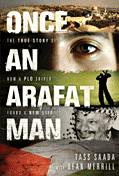
Once an Arafat Man: Good Reading!


Today I finished reading Once an Arafat Man by Tass Saada with Dean Merrill. It is Tass' biography/autobiography of his life. He was born in Palestine and then forced to move with his family and live as a refugee. He joined the Fatah and fought under Yasser Arafat. This book is his story--of both his life and his faith.

Last week, we watched the movie, The Kingdom. It was a powerful and frightening movie. As I read the first part of this book, I put Tass's story in the context of what was in that movie to help me picture what he did and what life was like for him. The first half of the book is very easy to read, not too gory or bloody in its description. It isn't especially engaging writing, but the first half does convey the story of Tass's life well. The second half is really what makes this book worth reading. There are a lot of interesting things to think about in the second half. Pg. 196-200 were particularly powerful to me. On page 197, there is a quote near the bottom that I think is worth pondering...

"The pattern of finessing the truth, of saying one thing but doing another, is epidemic in Middle Eastern politics. It explains why progress is often so excruciatingly slow. It also illustrates the desperate need on all levels, from high government halls to the common street, to speak honestly and accurately about one's intentions."

I think that right now the same could often be said about politics in the U.S., but I think that is a whole other kettle of fish and I don't know that in the U.S. we finesse the truth quite the way it is culturally acceptable to do so in the Middle East.

I appreciated Saada's description of the Israeli-Palestinian conflict as well as what he believes are the reasons behind it. I think it would be good for every Christian to read this part of the book. I think it would give us all great deal of compassion for the Palestinians and understanding.

Last year, I read Jimmy Carter's second book about Palestine and Israel. It was very good (as was the first), but this book is different because it comes from an insider. Saada above all wants peace for all and truly wants to live out the Lord's command for us to Love One Another as God has loved us. This book is such a worthwhile read!

Please note... I was provided with this complimentary copy from Tyndale, but I would have read it on my own. If you want to understand the Israeli-Palestinian Conflict, read Jimmy Carter's book Palestine: Peace, not apartheid and this book. The two books are different, but I think they compliment each other.

Comments

Popular posts from this blog

Grieved

Why is it that my generation (I belong to Gen X) and generations after us always seem to think that they know more than the generations that have come before us? Why is there such a lack of respect in our generation for our elders? Why do we think that the liturgy of the church and hymns are irrelevant? It is ironic to me that the emergent movement is saying that the seeker sensitive movement is irrelevant. It seems as if it was only a few years ago when it was the seeker sensitive movement that said to the traditional church that it (the traditional church) was irrelevant. I'm reading a book with all of these big words and I want to be honest--I didn't understand a lot of it. I'm not dumb. I understood most of it, but the author was assuming a lot of background knowledge on the part of the reader. Most of the time I learn deep theological concepts and then I have to store them in my "attic" (as Autumn would say) because there isn't enough room in the ...

Missing Pieces

The other day I was discussing a book with my mom and explaining to her my concern about how "blame" is cast upon the child in the story.  My mom commented about how deeply I read and consider what is written. Sometimes I wonder if I go overboard.  Am I questioning too much?  Am I overreacting? Why am I reacting this way? I come back to knowing that God wired me this way.  But, I also reflect on how God has guided my path through the maze of books I've read over the past few years and what I've learned from the books themselves and from reading them.   Recently, I read a book that troubled me.  The book I finished reading was  Guiltless Living  by Ginger Hubbard.  When I began reading it, I found myself puzzled and then disconcerted. And in the end, I cried. But, I cried for a different reason than one might suspect. I'd like to explain. I did not read Ms. Hubbard's previous book “ Don't Make Me Count to Three ”, but I knew from f...

ESV, NIV, or NASB and then there's the ICB, ESV or NIrV...which should we read?

I am so thankful for my friend's question about the ESV vs. NASB and NIV. I couldn't remember the difference so I went to look it up. I knew that John Piper and Tim Keller, both pastors and authors that I deeply respect have switched over to the ESV. All of the churches that we have attended over the past few years PCA or Reformed Baptist have also switched to the ESV. I did find a blog that explained the differences and that helped me ( http://thefoolishgalatian.wordpress.com/2007/10/22/niv-vs-esv-and-why-piper-switched/ ) I knew why I didn't like the KJV--it was written in the days when writers were paid by a patron and that often slanted the translation. The NKJV, from what I understand, is a revision of the KJV that uses more modern language. Most churches I have attended used the NIV until the ESV came out. The blog I found explained that the ESV is a more literal translation---like the NASB. The NASB is a very literal translation. The ESV has come to be consid...