After my oldest daughter finished kindergarten, I realized that what everyone had been telling me was true... The most important skill for children to work on in kindergarten is reading. Before Autumn learned to read, reading was the subject I was most anxious about. My student teaching was in first, third, and fifth grades. I did fine in third and fifth grades, but my first grade supervising teacher gave me only a satisfactory rating and suggested that I really needed to work on my patience. She was right. I did. But, the other lesson I learned during my time with the first graders was what an amazing process it is when a child learns to read.
 Because of my experiences with each of these programs, I am always curious about new phonics programs that I hear about. There is a program that I've been curious about for quite some time titled Eagle's Wings Comprehensive Handbook of Phonics for Spelling, Reading, and Writing. What I knew about this program was that it advocated teaching children the 600 most common words that make up the bulk of our communication to help children read more fluently. What I didn't realize was that this program is much more than just those sight words.
Our brains must first connect symbols to sounds. Then, we connect letter sounds together to make words. Then, those words are connected together to express thoughts. It truly is an amazing feat.
My awe of this process made me very apprehensive about teaching Autumn to read. She actually learned her letter sounds from the Leapfrog Letter Factory DVD. Then, I started with the Ordinary Parent's Guide to Reading. The words in the manual were small and Autumn didn't understand rhyme. That guide is one you have to use from the very beginning--to teach the letter sounds and then move on from there. I have met a few parents that liked this manual. But, I'm not one of them. The font is small for children to read and there was too much material covered in one lesson for my daughter and I. After spending three weeks on one lesson, I decided to try another program several friends had used--How to Teach Your Child to Read in 100 Easy Lessons.
We switched over and I began to see the logic in the program. One of my favorite parts is that the words and letters start off in a large size font. It is easy for children to read. It is scripted, but I don't have to depend on the script (or really use it much actually). The lessons are short enough for a kindergartener to do one lesson per day. I do a series of 5-10 lessons and then repeat the series until my child knows all the sounds and words easily and then we move on to the next lessons.
100 Easy Lessons is incomplete though. I found that when my oldest daughter had completed the program, she was in need of more practice breaking down longer words, so I used Phonics Pathways. She read through 2 pages a day until we completed the book. It filled in the gaps from 100 Easy Lessons by giving her a lot of practice with each digraph and consonant blend.
As Autumn finished 100 Easy Lessons, I had the opportunity to review Hooked on Phonics. It was fun reinforcement for Autumn. The program depends primarily on rhyming word families to help teach a child how to read. Rhyming doesn't click for all students, though. Autumn now knows how to rhyme well, but that skill developed long after she read competently.
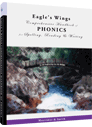
This week I've had the opportunity to look over this program and read the Program Guide. It is packed full with information. I want to pause and specify what kind of teacher I am... I am one of those teachers that likes books I can open right up and teach from. I also like teacher's manuals that are brief and to the point. It is also much easier for me to use curriculums when the font is an easy size to read and when there is spacing and bolding/underlining that makes it easy for one's eyes to gravitate to the main points and key details. Because this book is not designed or formatted in any of these ways, this book is not what I would typically choose to use in my home.
The Eagle's Wings book uses a small font and has broad guidelines for how to teach a child phonics. There are yearly goals and instructions on how to use the reading charts and implement them in your lessons. There is also handwriting, writing, and spelling instructions. As I read through the manual, I felt that the authors had a lot of great ideas. It would also be possible to use part of this program and not all. The section that includes the charts of common sight words and the instructions of how to teach them could be a very useful tool that could supplement any other reading program. The handwriting instructions were also helpful and could be used by a parent who did not want to buy penmanship books, but rather use blank paper and design their own daily handwriting lessons.
That is who this book would be best for--someone who wants some basic guidelines of what to teach a child for reading instruction, but not daily lesson plans or . If you plan on unschooling or teaching using a Montessori type approach, this book could be helpful because it would help you identify what sounds and words your child needs to learn to become a fluent reader. But, as for someone like me, this book is very overwhelming. There is a large amount of reading that needs to be done in the manual before you are able to use this program. You need to underline, take notes, and process all of the instructions. I do not have the focus or time to pursue using a program that would require such a commitment from me. I need to grab-n-go. I have been challenged to spend more time on my daughter's writing lessons this year, but that time is interaction time, not planning time which is difficult to come by.
I am glad that I had the chance to look over this program. It reminded me of how different we all are in our approaches to teaching and the resources we have available to us to teach our children. I am sure that many families have used this program. In my opinion, it would be more difficult to use than Phonics Pathways, which takes a similar approach in many ways, except that the font size is larger and Phonics Pathways is a grab-n-go kind of program. I do happen to have an extra copy of the Eagle's Wings Phonics book, so if you happen to live locally to me and would like it, just shoot me an email!
Please note that I received a complimentary copy of this book for review from the publisher.
Comments