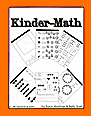
I have been writing a slew of reviews lately and I have one more today. It is for Kinder-Math. It's a lesser known kindergarten math curriculum by Susan Mortimer and Betty Smith.
There are all sorts of math curriculums available today. There's traditional math curriculums. There's modern, brightly colored math curriculums. There's mastery curriculums, like Singapore Math, and then there's spiral curriculums, like Saxon. I've looked at a lot of them over the past few years. Much of that is because I had to switch math curriculums in first grade because Autumn was stuck and not going anywhere. Her struggles compelled me to compare math curriculums and think about what made them different from one another.
For preschool, I use a book by Kathy Richardson titled Developing Number Concepts: Counting, Comparing, and Pattern. I highly recommend this book for preschool, because it explains the basic number concepts children need to learn in order to develop number sense. I also use this as a supplement to my kindergarten math curriculum. The one catch about that book is that it is not a homeschool book. It is made for use in the classroom, so some of the activities have to be modified for home teaching.
With my oldest daughter for kindergarten, I used Singapore Math Standards Edition. I loved the first half of the year with this curriculum, but began to realize I had to have the $50 teacher's edition to teach the second half. We made it through, but I chose not to use this curriculum with my second daughter for kindergarten. Instead, I switched to HSP Math K. Sami whizzed through the Kindergarten book it in one quarter and we spent the rest of the year slowly working our way through HSP Math 1, which we are continuing with this year. I don't typically recommend HSP Math for a few reasons. I do love it a lot, but you can't get teacher's manuals for it. Math is also my favorite subject so HSP Math works okay for me and my children even though it only has a few instructions.
I have noticed several things about curriculums.
1) More words doesn't necessarily mean better lessons.
2) Big, color graphics don't necessarily mean better comprehension.
3) Newer isn't always better.
 Keeping these things in mind, I want to review Kinder-Math. What kind of curriculum is Kinder-Math? It is a mastery curriculum--one that teaches a concept fully and then moves on to the next concept. It was published in 1995 and is printed in black and white. The set comes with one student work book and a teacher's manual. It is $15 for the set. The workbook is not reproducible, so you will need to purchase additional workbooks for your other children for $5 each. The price makes this a very affordable kindergarten math curriculum.
At first, this curriculum might strike you as not being enough. It may surprise you that the concepts in this book are all that a child needs to learn in Kindergarten for math. I looked through what is covered in this book and compared it to World Book's Scope and Sequence for kindergarten. There were a few minor topics that are missed. They are Estimation (which my public school curriculum doesn't cover until 1st), Sequence of Events, Calendar, Introduction to the Number Line, Subtraction, and Basic Charts and Graphs. The topics covered by this curriculum include counting by 1s, 2s, 5s, and 10s, counting to 100, time, money, geometry, greater than and less than, and addition. As I read the teacher's guide, I was struck by how simple and easy to use it was. It may seem thin and give you the first impression that it's not worth reading. This is simply not true! Read it please! There's great ideas in it!
What stands out to me about this curriculum? The first thing that caught my attention is how they teach the numbers 1-100. They have flash cards for the 10s numbers and others for the single digits that children place over them to make the numbers in successive order. What a great idea! I also particularly liked how the authors explain how to teach the clock. I looked over Horizons Math curriculum one time and the instruction I found in their book was "Teach the clock." I thought, "But, I want to know how!" There is a big emphasis put on counting by 1s, 2s, 5s, and 10s. This will help children a lot by building a base for the mental math they'll do down the road. I also like the 100s chart in the workbook because the tens digits are on the left side of the chart. If you start with 0, it makes a lot of sense to have the tens on the left side.
Who is this curriculum great for?
1) Someone who doesn't have a lot of space. A missionary or anyone who lives in small quarters.
2) A child who's fine motor skills are lagging behind their ability to do math. This curriculum is good for beginning writers. It's verbal and hands on.
3) A 4 year old preschooler who's ready for kindergarten math, but not an intensive program.
4) A family who's looking for a very inexpensive, traditionally taught math program that will cover the bases for kindergarten.
What about what the program's missing?
+ I had to supplement even Singapore's math with a book titled Sort, Graph, and Tally from Teacher Created Resources. This book would be a great supplement to this program and it's reproducible. That covers Basic Charts and Graphs.
+ For introducing the number line, bring out a measuring tape used to make clothing. Count up and down the number line with your child. When you are doing the counting exercises in this curriculum, use this tool. It is a number line!
+ Sequence of Events... While you are out with your child discuss what you are going to do first, next, and last. When you cook, use a recipe card that says 1, 2, 3. Point this out to them. When you have an old storybook that is missing a few pages, cut it apart and have your child put it in order.
+ To teach the calendar--keep one in your classroom. Let your child put an X on each day that passes. Say the date together... Wednesday, September 28th, 2011. Mark special events on your calendar so they can begin to develop a sense of future events. Look through the calendar at the end of the year and talk about past events. Every morning write the date on a chalkboard.
+ Lastly, subtraction. I'd recommend Kathy Richardson's book. If you buy it for preschool, you'll be able to use it to teach subtraction in kindergarten and also have additional lessons for addition.
How much time do the lessons take? How do you plan with this curriculum? Read through the unit's plans. Pick out 2-3 activities for the first day. See how your child responds and how long it takes. For a preschooler or kindergartener, you probably only want to spend 15-20 minutes a day on math. If they can only sit still for 10 minutes, then do 10 minutes and work your way up to 15 minutes. After you've discovered how much you can do in that span of time, plan out a week's math activities based on the units. Some units will probably take longer than others. You can plan on spending 2 weeks on each unit to start with.
I know that starting to homeschool can seem daunting. This is a basic curriculum that's going to remind you of how you learned as a child. If you use this curriculum with Kathy Richardson's book and a book like the Graph, Sort, and Tally book, your child will learn what he or she needs to know in kindergarten!
Please note that I received a complimentary copy of this book from the publisher for review.
There are all sorts of math curriculums available today. There's traditional math curriculums. There's modern, brightly colored math curriculums. There's mastery curriculums, like Singapore Math, and then there's spiral curriculums, like Saxon. I've looked at a lot of them over the past few years. Much of that is because I had to switch math curriculums in first grade because Autumn was stuck and not going anywhere. Her struggles compelled me to compare math curriculums and think about what made them different from one another.
For preschool, I use a book by Kathy Richardson titled Developing Number Concepts: Counting, Comparing, and Pattern. I highly recommend this book for preschool, because it explains the basic number concepts children need to learn in order to develop number sense. I also use this as a supplement to my kindergarten math curriculum. The one catch about that book is that it is not a homeschool book. It is made for use in the classroom, so some of the activities have to be modified for home teaching.
With my oldest daughter for kindergarten, I used Singapore Math Standards Edition. I loved the first half of the year with this curriculum, but began to realize I had to have the $50 teacher's edition to teach the second half. We made it through, but I chose not to use this curriculum with my second daughter for kindergarten. Instead, I switched to HSP Math K. Sami whizzed through the Kindergarten book it in one quarter and we spent the rest of the year slowly working our way through HSP Math 1, which we are continuing with this year. I don't typically recommend HSP Math for a few reasons. I do love it a lot, but you can't get teacher's manuals for it. Math is also my favorite subject so HSP Math works okay for me and my children even though it only has a few instructions.
I have noticed several things about curriculums.
1) More words doesn't necessarily mean better lessons.
2) Big, color graphics don't necessarily mean better comprehension.
3) Newer isn't always better.
At first, this curriculum might strike you as not being enough. It may surprise you that the concepts in this book are all that a child needs to learn in Kindergarten for math. I looked through what is covered in this book and compared it to World Book's Scope and Sequence for kindergarten. There were a few minor topics that are missed. They are Estimation (which my public school curriculum doesn't cover until 1st), Sequence of Events, Calendar, Introduction to the Number Line, Subtraction, and Basic Charts and Graphs. The topics covered by this curriculum include counting by 1s, 2s, 5s, and 10s, counting to 100, time, money, geometry, greater than and less than, and addition. As I read the teacher's guide, I was struck by how simple and easy to use it was. It may seem thin and give you the first impression that it's not worth reading. This is simply not true! Read it please! There's great ideas in it!
What stands out to me about this curriculum? The first thing that caught my attention is how they teach the numbers 1-100. They have flash cards for the 10s numbers and others for the single digits that children place over them to make the numbers in successive order. What a great idea! I also particularly liked how the authors explain how to teach the clock. I looked over Horizons Math curriculum one time and the instruction I found in their book was "Teach the clock." I thought, "But, I want to know how!" There is a big emphasis put on counting by 1s, 2s, 5s, and 10s. This will help children a lot by building a base for the mental math they'll do down the road. I also like the 100s chart in the workbook because the tens digits are on the left side of the chart. If you start with 0, it makes a lot of sense to have the tens on the left side.
Who is this curriculum great for?
1) Someone who doesn't have a lot of space. A missionary or anyone who lives in small quarters.
2) A child who's fine motor skills are lagging behind their ability to do math. This curriculum is good for beginning writers. It's verbal and hands on.
3) A 4 year old preschooler who's ready for kindergarten math, but not an intensive program.
4) A family who's looking for a very inexpensive, traditionally taught math program that will cover the bases for kindergarten.
What about what the program's missing?
+ I had to supplement even Singapore's math with a book titled Sort, Graph, and Tally from Teacher Created Resources. This book would be a great supplement to this program and it's reproducible. That covers Basic Charts and Graphs.
+ For introducing the number line, bring out a measuring tape used to make clothing. Count up and down the number line with your child. When you are doing the counting exercises in this curriculum, use this tool. It is a number line!
+ Sequence of Events... While you are out with your child discuss what you are going to do first, next, and last. When you cook, use a recipe card that says 1, 2, 3. Point this out to them. When you have an old storybook that is missing a few pages, cut it apart and have your child put it in order.
+ To teach the calendar--keep one in your classroom. Let your child put an X on each day that passes. Say the date together... Wednesday, September 28th, 2011. Mark special events on your calendar so they can begin to develop a sense of future events. Look through the calendar at the end of the year and talk about past events. Every morning write the date on a chalkboard.
+ Lastly, subtraction. I'd recommend Kathy Richardson's book. If you buy it for preschool, you'll be able to use it to teach subtraction in kindergarten and also have additional lessons for addition.
How much time do the lessons take? How do you plan with this curriculum? Read through the unit's plans. Pick out 2-3 activities for the first day. See how your child responds and how long it takes. For a preschooler or kindergartener, you probably only want to spend 15-20 minutes a day on math. If they can only sit still for 10 minutes, then do 10 minutes and work your way up to 15 minutes. After you've discovered how much you can do in that span of time, plan out a week's math activities based on the units. Some units will probably take longer than others. You can plan on spending 2 weeks on each unit to start with.
I know that starting to homeschool can seem daunting. This is a basic curriculum that's going to remind you of how you learned as a child. If you use this curriculum with Kathy Richardson's book and a book like the Graph, Sort, and Tally book, your child will learn what he or she needs to know in kindergarten!
Please note that I received a complimentary copy of this book from the publisher for review.
Comments